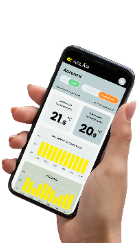
Flow temperature is the temperature of the water leaving a heating source and travelling towards the radiators or underfloor-heating circuit. It influences how much heat those surfaces can release into your rooms and how efficiently an air-to-water heat pump can operate.
It is different from the temperature you want in your living room, and it is not the same as your hot-water cylinder setting.
At Adlår, we separate space heating and hot water. Aurora II heats the home, while a separate heat pump built into the Fjord Pro heat-pump hot-water cylinder heats water for taps and showers. This means producing hot water does not require Aurora II to divert away from space heating.
The key change is understanding the temperature of the water doing the heating, alongside how comfortable the rooms feel. A room thermostat reports conditions where it is fitted; the heating-water temperature helps explain how the system is delivering warmth and an important influence on its efficiency.
If you have been researching heat pumps, you will probably have seen advice about “lower flow temperatures”. The important question is what that means for your home: how can the system use lower-temperature water while still keeping every room comfortable?
This guide explains the term, how it relates to performance and what to discuss with your installer. It covers water-based space heating, rather than the air delivered by a conventional split air-conditioning system.
What does flow temperature mean?
In a water-based heating system, heated water travels through a circuit to supply radiators or underfloor heating. Those surfaces transfer heat into the rooms. The water then returns towards the heating source to be reheated.
The temperature on the outgoing side is the flow temperature. On the returning side, it is the return temperature.
The exact reading depends on where the sensor is installed. A reading at the heat pump is not necessarily identical to the temperature entering every radiator, particularly where there are separate circuits, mixing arrangements or other components between them.
Four temperatures that mean different things
Temperature | What it describes | What it does not tell you on its own |
Flow temperature | Water supplied towards the heating circuit | The air temperature in a room. |
Return temperature | Water coming back from the circuit | Whether every room is comfortable. |
Room temperature | Air temperature at a particular sensor or thermometer | The temperature of water inside the heating pipes. |
Hot-water cylinder temperature | A temperature measured within stored domestic hot water | The space-heating flow temperature. |
For example, a room could be maintained at 20°C while the heating circuit is supplied with water at 40°C. Those invented figures illustrate two different measurements; they are not recommended settings for your home.
Why a thermostat reading does not tell the whole story
A traditional room thermostat, perhaps in a hallway, measures the air temperature in that location. It cannot tell you whether an upstairs bedroom is comfortable, or how hot the heating water is. A comfortable hall reading can therefore sit alongside a cold bedroom or an unnecessarily high water-temperature setting.
Flow temperature adds a different view: the temperature being supplied to the heating circuit, rather than the air in one room. That makes it useful when reviewing how the heating system is operating across the home. It does not prove that every room receives enough heat, and it is not a measurement of the total heat delivered.
This is why we look beyond the thermostat setting. Producing hotter water generally asks more of the heat pump. If the home stays comfortable with a lower, suitable flow temperature, the system can benefit from that efficiency opportunity. A room-temperature reading alone cannot reveal it.
Room temperature tells you about the result in that location. Flow temperature helps explain how the heating is achieving it. For a heat pump, understanding both gives you a more useful picture than watching a thermostat alone.
What about thermostats and zones in every room
Room controls can help manage individual comfort, and properly designed zoning can work with heat pumps. But a set of room targets still does not show whether the central heating-water temperature is appropriately matched to demand. A zoned system can also use weather compensation and provide energy monitoring; zoning does not inherently remove that visibility.
The important check is whether room comfort and water-temperature control work together. A flow temperature of 35–40°C is useful context, not proof of efficiency by itself. Outdoor conditions, circulation and measured heat output and electricity input also matter when assessing performance.
Why does flow temperature affect heat-pump efficiency?
A heat pump transfers heat from its source, such as outdoor air, into the heating system. Producing hotter heating water generally requires it to work harder under otherwise comparable conditions.
That is why reducing an unnecessarily high flow temperature can improve efficiency: the heat pump may need less electricity to deliver the required heat.
But efficiency is not determined by flow temperature alone. Outdoor conditions, equipment performance, water flow, controls and installation design also matter. Two homes operating at the same flow temperature will not necessarily have the same consumption or running costs.
The aim is the lowest appropriate flow temperature that still allows the system to maintain the designed comfort, within its operating requirements. A lower number is not an improvement if it leaves rooms underheated.
There is also no fixed percentage saving that applies to every one-degree reduction. Treat any such estimate as dependent on the equipment and operating conditions, rather than a promise about your bill.
Aurora II SCOP at different flow temperatures
The following figures are published in Adlår’s pre-installation FAQ as MCS SCOP values for the Aurora II 6 kW, 10 kW and 14 kW models. They show the efficiency advantage of lower heating-water temperatures under the relevant rating conditions.
Flow temperature | Aurora II 6 kW | Aurora II 10 kW | Aurora II 14 kW |
50°C | 3.48 | 3.47 | 3.46 |
45°C | 3.82 | 3.79 | 3.77 |
40°C | 4.15 | 4.09 | 4.10 |
35°C | 4.49 | 4.40 | 4.42 |
Source: Adlår’s Aurora II flow-temperature and SCOP guidance. These figures apply to the models named; they should not be assumed to apply to other Aurora variants.
SCOP means seasonal coefficient of performance. It describes heat delivered relative to electricity consumed over standardised seasonal rating conditions. A SCOP of 4.15 represents 4.15 units of heat per unit of electricity under those conditions. It is not a guarantee of the same result in every installed home, and it does not include the separate Fjord Pro’s performance.
Across the three models, the table shows:
50°C to 40°C: approximately 18–19% higher SCOP.
50°C to 35°C: approximately 27–29% higher SCOP.
The 6 kW model has the highest listed SCOP at 35°C and 40°C, but capacity should still be selected to meet the property’s assessed heat demand. Choosing a smaller unit for its efficiency figure alone would not establish that it is suitable.
Higher SCOP is not the same percentage reduction in electricity use
For the same amount of delivered heat, electricity use varies inversely with efficiency. As a simplified example, delivering 10,000 kWh of space heat at a SCOP of 3.48 would require about 2,874 kWh of electricity. At 4.15, it would require about 2,410 kWh: approximately 16% less, rather than 19% less.
This calculation illustrates the relationship using the 6 kW table values. It is not a forecast of annual demand, measured household performance or a bill saving. Actual cost also depends on the electricity tariff and operating conditions.
For background on this relationship, see the Energy Saving Trust’s heat-pump design guidance.
What is the best flow temperature for a heat pump?
There is no single best flow temperature for every heat pump or home. The appropriate temperature depends on the building’s heat loss, the radiator or underfloor-heating capacity, outdoor conditions and the system’s design.
Your installer should establish how much heat each room needs and whether its heating surfaces can deliver that heat at the proposed water temperatures.
A well-insulated room with suitable heating surfaces may remain comfortable with lower-temperature water. Another room with greater heat loss or insufficient radiator output may need changes to the design to achieve the same result.
Comparing your setting with a neighbour’s therefore tells you very little without understanding both installations.
What does Adlår aim for in normal operation?
Our aim is to design and commission the heating system to maintain comfort at the lowest suitable water temperature. Where the home and emitters allow, this can mean operating around 35–40°C during milder conditions, with higher temperatures when required in colder weather.
This is a design objective, not a fixed setting for every home or every winter day. A system may need a higher temperature during colder conditions. The assessment should establish what works for your rooms, rather than assume that a particular radiator type or insulation label guarantees a temperature.
Correctly sized radiators, suitable fan-assisted emitters where appropriate, insulation improvements and professional hydraulic balancing can support lower-temperature operation. Which measures are worthwhile depends on the installation.
What is a design flow temperature?
The design flow temperature is a temperature selected for the system’s design conditions, including the outdoor temperature used to calculate the home’s winter heating requirement.
It is not necessarily the temperature the system supplies every day. With weather compensation, the heating-water target can reduce in milder weather and rise as conditions become colder.
Why might your heat-loss report show 50°C when everyday operation is lower?
A report might specify 50°C to meet the assessed room heat losses at the selected cold-weather design conditions. That is a requirement for those conditions, rather than an instruction to supply 50°C throughout winter.
When the weather is milder, the home generally loses less heat. Weather compensation can then lower the water-temperature target while maintaining comfort. Depending on the home and emitters, an installation designed around 50°C may therefore operate at 35–40°C for portions of the season. The design and commissioning information should explain what is expected for your property.
Heat-loss calculations use assumptions about the building, ventilation and design conditions. Some assumptions may be cautious, particularly where construction details are uncertain. That does not establish a fixed error margin or mean every report overstates heat loss by the same percentage. The calculated cold-weather requirement should still be taken seriously.
Outdoor design temperatures and the hours spent near them vary with location and weather. Ask which outdoor temperature was used for your property rather than assuming a single UK-wide figure.
Design information | Everyday operation |
Assesses the heat required at specified cold-weather conditions | Responds to the weather and the demand at that time. |
Establishes emitter and system requirements at the selected design flow temperature | May use lower-temperature water when less heat is needed. |
Provides the basis for the installation design | Is checked through commissioning, room comfort and operation. |
Read Adlår’s explanation of flow temperatures in heat-loss reports alongside the figures for your own home.
When discussing a quotation, ask: “What flow temperature is this system designed around, under what outdoor conditions, and how has radiator or underfloor-heating output been checked?”
That gives you a more useful explanation than being told the heat pump can reach a particular maximum temperature.
Does a higher maximum temperature mean a better heat pump?
A model’s maximum capability and the temperature your home needs are different questions. High-temperature capability may be relevant to a particular design, but it does not establish the efficiency or suitability of the whole installation.
Look for a design explanation covering room comfort and expected performance at the proposed operating conditions.
How does flow temperature affect radiators and underfloor heating?
A radiator releases heat because it is warmer than the room around it. Lowering the heating-water temperature generally reduces the output of the same radiator under otherwise comparable conditions.
This does not automatically mean the room becomes cold. The radiator may still provide enough heat, particularly where the system operates for longer periods and the room’s heat loss is modest.
Why might a larger radiator help?
A radiator with greater effective heat output can help meet a room’s demand using lower-temperature water. Whether a replacement is needed depends on the existing radiator and the room, rather than the fact that a heat pump is being installed.
A radiator’s advertised output also relates to specified test conditions. Its output at a lower water temperature needs assessing using suitable manufacturer data; the headline rating alone is not enough.
Illustrative example: two bedrooms have identical radiators, but one has more exposed walls and larger windows. The same water temperature may provide sufficient heat in the sheltered bedroom while leaving the other underheated. That points to a room-specific design question, not a universal need to raise the whole house’s setting.
See whether radiators or insulation need upgrading for a heat pump for more on the assessment.
What about underfloor heating?
Underfloor heating distributes heat across a larger area and can be designed for relatively low water temperatures. Its requirements still depend on the pipe layout, floor construction, coverings and room heat loss.
Where a home has radiators and underfloor heating, the circuits may have different requirements. Follow the design and commissioning guidance rather than adjusting a mixing valve or manifold to copy another system’s temperature.
Why does flow temperature change through the day?
With weather compensation, the heating-water target changes in response to outdoor temperature. Colder conditions generally require more heat; milder conditions require less.
A heat curve defines the relationship between the outdoor temperature and the target flow temperature.
With Aurora II, the heating curve determines the target heating-water temperature as outdoor conditions change. This is different from choosing the room temperature on a thermostat.
For example, a system might target 35°C water in milder conditions and 45°C in colder conditions. These are illustrative figures, not an Adlår curve, a recommended range or predictions for your home.
Seeing the target rise during a cold spell does not, by itself, mean the controls are malfunctioning. The useful check is whether the response maintains comfort and is consistent with the commissioned setup.
Actual readings can also differ from the target as equipment responds to demand or moves through operating stages. A single screenshot is not a complete assessment of performance.
Our guide to smart heating controls, heat curves and weather compensation explains how these controls manage the temperature supplied to the heating system.
What is the difference between flow temperature and flow rate?
Flow temperature describes how hot the heating water is. Flow rate describes how much water moves through the circuit over time. They are separate measurements.
A system needs both appropriate water temperatures and appropriate circulation to deliver heat. Raising the temperature is not a substitute for resolving a circulation problem.
Return temperature provides another useful measurement. The difference between flow and return is sometimes called delta T or ΔT. Engineers assess it alongside flow rate and other operating information.
There is no single difference between flow and return that a homeowner should try to force onto every installation. Do not adjust pumps, balancing valves or circuit settings to achieve a figure found online.
Is space-heating flow temperature the same as hot-water temperature?
No. Space-heating flow temperature concerns the water supplying radiators or underfloor heating. Domestic hot-water temperature concerns the water stored or supplied for taps and showers.
Their relationship depends on the system. In some installations, one heat pump alternates between space heating and heating a hot-water cylinder.
In Adlår’s dual system, Aurora II supplies space heating and Fjord Pro uses its own built-in heat pump to heat stored water for taps and showers. It is not a conventional cylinder heated by Aurora II.
When Fjord Pro reheats your stored hot water, Aurora II can continue supplying your radiators or underfloor heating according to the home’s heating demand. The space-heating circuit follows its own temperature requirements, while hot water is heated separately.
The benefit is avoiding a pause in space heating for cylinder reheating. It does not mean Aurora II runs continuously: it can still modulate, cycle or defrost as required. Nor does separation automatically reduce the temperature your radiators need; room heat loss and radiator or underfloor-heating output still determine that. A single heat pump can also use different temperatures for heating and hot-water modes; Adlår’s system handles the duties independently.
Read more about Adlår’s dual heating and hot-water system.
Do not lower cylinder temperatures or disable hygiene programmes because you have read advice about reducing space-heating flow temperature. Follow the hot-water guidance for your installed equipment.
Should you adjust your heat pump’s flow temperature?
Start with the settings established at commissioning. If your home is comfortable, a changing water-temperature reading is not, on its own, a reason to intervene.
Where fine-tuning is appropriate, use the everyday controls and model-specific instructions explained by your installer. A system using a heat curve may need a curve adjustment rather than a fixed manual water-temperature setting.
The everyday principle can be simple: if the home is consistently too cool, use the agreed comfort control to request a little more warmth; if it is too warm, request a little less. Where that interface adjusts the heating curve, the system changes its water-temperature target while weather compensation continues to respond to conditions. Follow the instructions for your installed controller: a button direction or curve number does not mean the same thing on every interface. Check whether the concern affects the whole home or just one room before changing the overall setting.
Before changing anything, identify the problem:
What you notice | Useful next step |
The home is comfortable but radiators feel cooler than expected | Check room comfort and the meaning of the displayed reading before changing settings. |
Most rooms are consistently too warm or too cool | Record the pattern and ask about the heating settings, schedule and curve. |
Only one room remains cold | Investigate that room’s heat loss, heating output and controls. |
Rooms are comfortable in mild weather but struggle when it gets colder | Record when the pattern appears so the design and curve can be reviewed. |
Heating is unavailable or a fault keeps appearing | Contact support; do not treat this as routine temperature fine-tuning. |
If an adjustment is agreed, record the original setting, change one thing at a time and allow the assessment period advised for your installation. Compare room comfort as well as the displayed temperature. Changes in weather can affect the result.
Avoid repeatedly changing several controls, altering installer parameters or using factory resets as a way to experiment.
For an Adlår installation, use the post-installation guidance or contact customer support if you are unsure which control applies.
How can you tell whether the flow temperature is appropriate?
A flow-temperature reading is useful information, but it is not a verdict on the system.
Consider it alongside:
Whether the rooms reach and maintain their intended temperatures.
The outdoor conditions and time of the reading.
Whether you are viewing a target, actual flow or return temperature.
The current heating settings and any recent changes.
Electricity use over a meaningful period and what the measurement includes.
A room reading and a water-temperature reading answer different questions. Use them together to assess comfort and understand operation; ask your installer to explain any recurring mismatch.
The right flow temperature starts with understanding your home. At an Adlår home survey, we assess room-by-room heat loss and existing radiators or underfloor heating, then explain the proposed system design and any recommended upgrades.
Book a free home survey to understand what would work for your property.