Most homeowners focus on the heat pump itself. But the real performance of a heating system comes from how it is designed, controlled, and commissioned.
Smart heating controls, weather compensation, and heating curves determine how your home actually feels day to day. They influence how the system responds to changing weather, maintains stable comfort, and protects long-term seasonal efficiency.
Without proper setup, even a well-installed system can underperform.
This guide explains how smart heating controls work, how heating curves and weather compensation affect performance, and how systems are tuned in real homes to deliver stable comfort, predictable running costs, and long-term reliability.
What Are Smart Heating Controls and Why Do They Matter?
To understand heat pump performance properly, you first need to understand how the system is controlled.
What Smart Heating Controls Actually Do
Smart heating controls manage how the heating system responds to changing conditions throughout the day.
A typical setup may include:
- A wireless smart control
- A central heating controller
- Indoor temperature monitoring
- Outdoor weather sensors
- Individual radiator valves
- Integrated hot water control
These components work together to monitor indoor and outdoor conditions and help the system respond more intelligently over time.
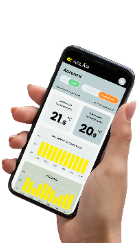
In Adlår systems, weather compensation remains the primary control strategy. Indoor temperature monitoring adds an additional layer of feedback that can help fine-tune comfort in changing conditions.
Rather than behaving like a traditional on/off boiler thermostat, the wireless smart control works within the Smart Life ecosystem to provide ambient room temperature monitoring.
This allows smart automations to adjust the heating curve dynamically.
For example:
- If room temperature drops below the target comfort range, the system can slightly increase the heating curve
- If room temperature rises above the target range, the system can gradually reduce output
This helps maintain stable comfort without disrupting the low-temperature, “low and slow” operation that heat pumps are designed for.
This additional layer of indoor feedback can be especially useful during spring and autumn, when outdoor temperatures fluctuate rapidly and some homes may benefit from finer system adjustment.
More advanced users may also integrate Home Assistant for:
- Additional room sensors
- Humidity monitoring
- Occupancy detection
- Predictive automations
However, Smart Life provides a much simpler off-the-shelf route for homeowners who want smarter control without building a fully customised system.
Why Smart Controls Improve Energy Efficiency
Smart controls improve energy efficiency by helping the system match heating output to real demand.
Rather than heating aggressively and switching fully on and off repeatedly, the system:
- Adjusts gradually
- Maintains stable operation
- Helps refine response based on changing indoor conditions
- Avoids unnecessary overheating
This protects seasonal efficiency while maintaining more consistent comfort throughout the home.
For example, if sunlight increases the indoor temperature naturally, the system can reduce output gradually rather than continuing to heat unnecessarily.
Because heat pumps operate most efficiently when running steadily, stable control strategies are extremely important.
Advice from Money Saving Expert also highlights that improving heating controls is one of the most effective ways to reduce overall heating costs.
In a connected smart home, these systems also provide better visibility of how energy is used throughout the property.
What Are Heating Curves and Why Are They Important?
Heating curves are one of the most important parts of how a heat pump operates.
Understanding Heating Curves in Simple Terms
A heating curve defines the relationship between outdoor temperature and flow temperature.
In simple terms:
- When it becomes colder outside, the system increases flow temperature
- When outdoor temperatures rise, the system reduces flow temperature
For example:
- 12°C outside → lower flow temperature
- 2°C outside → higher flow temperature
This does not mean the system suddenly becomes “hot” like a boiler.
Heat pumps are designed to operate using lower water temperatures over longer periods of time.
The goal is not rapid bursts of heat. The goal is stable comfort delivered efficiently.
Heating curves allow the system to respond automatically to changing weather conditions without requiring constant manual adjustment.
How Heating Curves Affect Comfort
Correctly configured heating curves help maintain stable indoor temperatures throughout the day.
They:
- Prevent sudden spikes in temperature
- Reduce overheating
- Maintain more even comfort across the home
- Protect system efficiency
If the heating curve is set too high, the system may produce more heat than the property actually needs. This increases energy use and can create overheating.
If the curve is too low, rooms may feel underheated during colder weather.
A properly tuned curve provides enough heat to maintain comfort consistently while keeping flow temperatures as low as possible.
This balance is central to long-term heat pump performance.
What Is Weather Compensation and How Does It Work?
Weather compensation works alongside heating curves to improve system performance further.
How Weather Compensation Uses Outdoor Sensors
Weather compensation uses an outdoor sensor to monitor changes in external temperature continuously.
The system:
- Tracks outdoor conditions in real time
- Adjusts flow temperature automatically
- Responds before indoor temperatures change significantly
This proactive approach helps maintain more stable indoor comfort.
Instead of reacting only after rooms become cold, the system anticipates demand based on changing weather conditions.
This is one of the biggest differences between a properly engineered heat pump system and traditional boiler-era heating behaviour.
The Benefits of Weather Compensation
The benefits of weather compensation include:
- More stable indoor temperatures
- Lower energy usage
- Reduced system cycling
- Better seasonal efficiency
- Improved long-term comfort
Because adjustments happen gradually, the system avoids large temperature swings and maintains a more predictable indoor environment.
Weather compensation is especially effective during milder weather, where maintaining low flow temperatures has a significant impact on overall efficiency.
How Heating Curves and Weather Compensation Work Together
These two functions must work together correctly for a heat pump system to perform properly.
Why These Settings Must Work as One System
The heating curve establishes the baseline relationship between outdoor conditions and flow temperature.
Weather compensation then continuously adjusts system behaviour based on outdoor temperature changes.
Indoor monitoring can then provide an additional layer of ambient feedback where required.
Together, these controls influence:
- Flow temperature
- System response
- Comfort stability
- Overall seasonal efficiency
For example, a sudden drop in outdoor temperature results in a gradual increase in flow temperature rather than an aggressive on/off response.
This helps the system remain stable, quiet, and efficient.
What Happens When They Are Set Incorrectly
If these settings are not configured properly:
- Flow temperatures may become unnecessarily high
- Rooms may overheat or feel underheated
- Energy use can increase significantly
- System cycling may become unstable
This is one of the most common reasons heat pump systems fail to deliver expected performance.
In many cases, the issue is not the heat pump itself.
It is the control strategy.
How Heat Pump Systems Are Tuned in Real Homes
This is where real-world performance is achieved.
Real-World Tuning vs Factory Settings
Many heating systems are left on generic factory settings after installation.
These settings are not tailored to the individual property.
As a result:
- Efficiency may be reduced
- Comfort can become inconsistent
- Flow temperatures may run unnecessarily high
- Running costs may increase
In real homes, systems need to be adjusted based on how the property actually behaves.
This process may include:
- Refining heating curves
- Adjusting weather compensation settings
- Monitoring indoor comfort over time
- Fine-tuning flow temperatures
This is why commissioning is such an important part of heat pump system design.
At Adlår, commissioning is treated as a performance step not simply a handover process.
Adjusting Heating Curves Over Time
System tuning is rarely a one-time adjustment.
Instead, it is usually a gradual process that improves performance over time.
This can involve:
- Monitoring indoor temperatures
- Observing how the property responds in different weather conditions
- Adjusting heating curves incrementally
- Refining flow temperatures carefully
For example:
- If rooms heat too quickly, the curve may be reduced slightly
- If rooms respond too slowly during colder weather, the curve may be increased gradually
This process helps create:
- Stable comfort
- Better seasonal efficiency
- More predictable running costs
- Long-term performance reliability
Common Mistakes with Smart Heating Controls
Even correctly installed systems can underperform if they are used incorrectly.
Treating Heat Pumps Like a Boiler
One of the most common mistakes is treating a heat pump like a traditional gas boiler.
This often includes:
- Turning the system on and off repeatedly
- Expecting rapid bursts of heat
- Constantly overriding control settings
- Disabling automated functions
Heat pumps are designed to run continuously at lower temperatures.
Interrupting this steady operation can reduce efficiency, increase cycling, and create less stable comfort.
This is why “low and slow” heating behaviour is so important.
Overriding Weather Compensation
Another common issue is overriding weather compensation settings manually.
For example:
- Constantly changing temperatures
- Disabling automatic control logic
- Running unnecessarily high flow temperatures
When this happens, the system loses its ability to optimise performance automatically.
This often leads to:
- Higher energy use
- Less stable comfort
- Reduced seasonal efficiency
In many cases, the best results come from allowing the system to operate steadily with only small adjustments where genuinely needed.
How Proper Control Settings Help You Save Money
Control strategy has a major impact on running costs.
Lower Energy Bills Through Better Control
When systems are tuned properly:
- Less energy is wasted
- Flow temperatures remain lower
- Output matches real demand more closely
- Seasonal efficiency improves
This can lead to lower heating costs while maintaining better comfort throughout the home.
Advice from Money Saving Expert also supports the idea that improved heating control is one of the simplest ways to improve energy performance.
Why Tuning Matters More Than Hardware Alone
Two homes can have the same heat pump equipment but deliver completely different results.
The difference is often how the system has been designed, commissioned, and controlled.
A well-tuned system:
- Maintains more stable comfort
- Uses less energy
- Operates more quietly
- Delivers more predictable performance
This is why controls, commissioning, and system design are just as important as the heat pump itself.
Get the Most from Smart Heating Controls
If you want the best possible performance from a heat pump system, controls matter just as much as the equipment.
A properly tuned system helps deliver:
- Stable indoor comfort
- Efficient low-temperature operation
- Predictable running costs
- Long-term reliability
If a system is not performing as expected, the issue is often not the heat pump itself.
It is usually how the system has been configured, controlled, or commissioned.
Understanding smart heating controls, heating curves, and weather compensation is one of the most important parts of getting long-term performance from a heat pump system.
When these systems are engineered correctly, they create homes that feel comfortable, efficient, stable, and easy to live with over time.