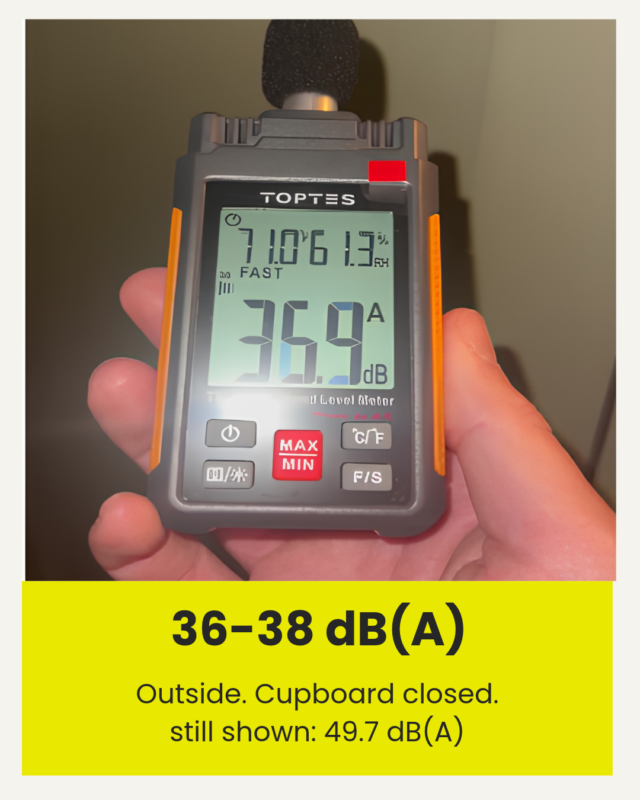
In this bedroom installation, the meter recorded approximately 36–38 dB(A) outside the closed, uninsulated cupboard while the original Fjord was operating.
When you are considering a heat-pump hot-water cylinder inside your home, the question is personal: what will you hear when you are using the room?
A published decibel figure can help compare appliances, but it does not describe exactly what will reach you from inside a cupboard. This example looks at an original Fjord in a bedroom, using the visible meter readings from a short recording to put the numbers in context.
This is the original Fjord, not Fjord Pro. The observations describe this installation and these measurement positions. They are not a laboratory test or a guaranteed noise level for another home.
The home and installation
The cylinder is installed in a bedroom cupboard with no added acoustic lining or sound-reducing insulation. The cupboard doors can be opened to access the cylinder and closed during normal use, subject to the installation’s required airflow and access arrangements.
That makes it a useful example of sound reaching the room without specialist treatment to the cupboard. It does not establish that every untreated cupboard will perform the same way.
The recording includes readings close to the cylinder, around the top and duct connections, and outside the cupboard with the doors closed.
What the meter recorded
Position and cupboard condition | Approximate observed sound-pressure level |
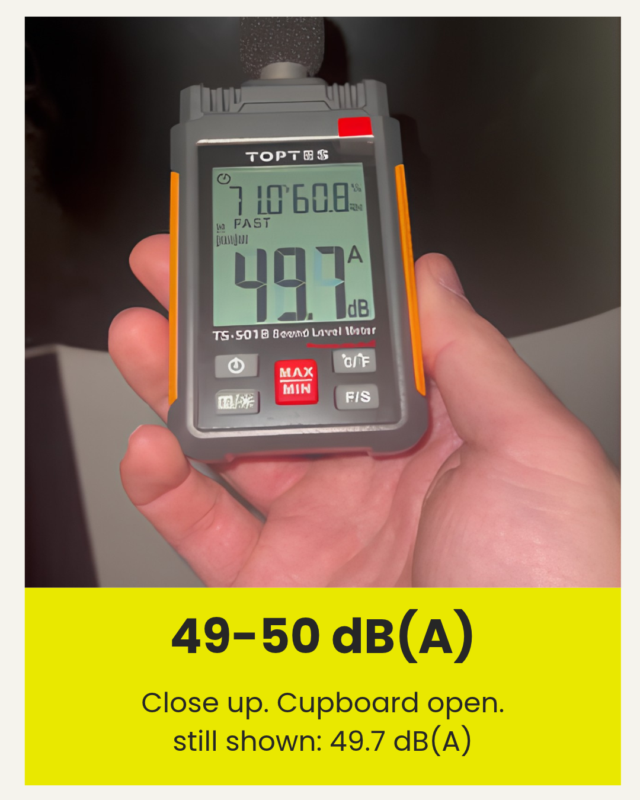
Close to the cylinder with the cupboard open | 49–50 dB(A) |
Near the top and duct connections | 51–53 dB(A) |
Outside the cupboard with the doors closed | 36–38 dB(A) |
These are approximate visible reading ranges, rather than measured time averages. The supplied assessment identifies A-weighting and FAST response on the meter display.
The main finding is the lower reading outside the closed cupboard compared with the close-up, open-cupboard readings. This gives a more useful view of the sound reaching the bedroom at that measurement position than a reading taken beside the equipment alone.
The microphone moves between sequences. Distance, cupboard doors, room reflections and background sound all affect what the meter records. The difference therefore cannot be attributed entirely to the doors, or turned into a certified acoustic rating for the cupboard.
What do those levels mean in everyday terms
For broad context, the US National Institute on Deafness and Other Communication Disorders gives examples of about 40 dB for a refrigerator hum and 45–65 dB for a running dishwasher.
Against those indicative examples, the open-cupboard readings sit towards the quieter end of a running dishwasher. The 36–38 dB(A) readings outside the closed cupboard are slightly below the refrigerator-hum reference.
These comparisons help place the numbers; they do not mean the Fjord sounds exactly like either appliance. The character of a fan or compressor hum, the surrounding background sound and your position in the room affect what you notice. A relatively low reading can still be audible in a quiet bedroom.
This recording does not establish whether the sound would disturb someone’s sleep. That is a separate question from the level shown on a handheld meter.
Why the meter reading differs from the product rating
The published product figure and the handheld reading describe different quantities: sound power and sound pressure.
Think of a light bulb. Its light output and the brightness reaching you are different things. Moving farther away or closing a door changes how much light reaches you without changing the bulb’s rated output. Sound power and sound pressure have a similar distinction.
Question | Sound power | Sound pressure |
What does it describe? | The appliance’s total acoustic output | The sound level at a particular position |
Does distance change it? | Distance does not change the rating | Yes, distance affects the reading |
Do doors and room reflections matter? | They do not alter the published rating | Yes, they affect sound reaching the meter |
What figure applies here? | Published original Fjord range: approximately 55 dB(A), depending on capacity | Approximately 36–38 dB(A) outside this closed cupboard |
Both levels use decibels, but they describe different physical quantities and use different reference values. Subtracting a 37 dB(A) handheld reading from a 55 dB(A) sound-power rating does not show that the cylinder is 18 dB quieter than specification.
The original Fjord product page lists sound-power levels of 55.0, 55.3 and 55.7 dB(A) for the 120, 200 and 300 litre versions respectively. The capacity in this home has not been confirmed in the supplied assessment, so one specific rating should not be assigned to the tested cylinder.
Published sound-power ratings are useful for comparing products assessed under equivalent conditions. Sound-pressure readings help describe what reaches a particular place in a room. This recording provides an example of the latter, rather than a check of the former.
A note on this home’s air intake
At this home, the intake draws air from inside the house. The arrangement was chosen with the aim of improving cylinder performance using warmer air. It is a detail of this installation and should not be taken as Adlår’s recommended installation method.
Warmer intake air can improve the cylinder’s coefficient of performance, or COP, under otherwise comparable conditions. However, the heating system may need to replace heat removed from the home. A higher cylinder COP therefore does not automatically mean lower whole-home energy use. No COP or whole-home energy measurements are provided by this noise recording.
MCS’s heat-pump design standard restricts the heat sources used by domestic hot-water heat pumps and requires heat extraction not to deplete heat from inhabited building space and increase its space-heating requirement. Intake and exhaust routes need to be assessed against the applicable standard and the equipment’s installation requirements.
This example helps explain sound in one location. It does not establish the installation’s compliance or energy performance, and the indoor intake should not be copied from it.
What this example can help you decide
The recording gives a practical reference for one original Fjord operating in a bedroom cupboard without added acoustic treatment. The readings outside the closed cupboard were lower than those close to the cylinder with it open.
For your home, the useful conversation is about the proposed location, the cupboard and ducting arrangements, and the room around them. Explain whether the position is close to a bed, a workspace or another area where background sound matters to you.
At an Adlår home survey, we can discuss the proposed cylinder location and your concerns about sound. Any new system should be assessed using its own model information and installation design; this original Fjord example should not be used as a prediction for Fjord Pro.
Book a free home survey to discuss what would suit your property.